
How to Build a Security Responsibility Matrix Before Outsourcing IT Operations
Network Operations Handover: What to Document Before Outsourcing Computer Security
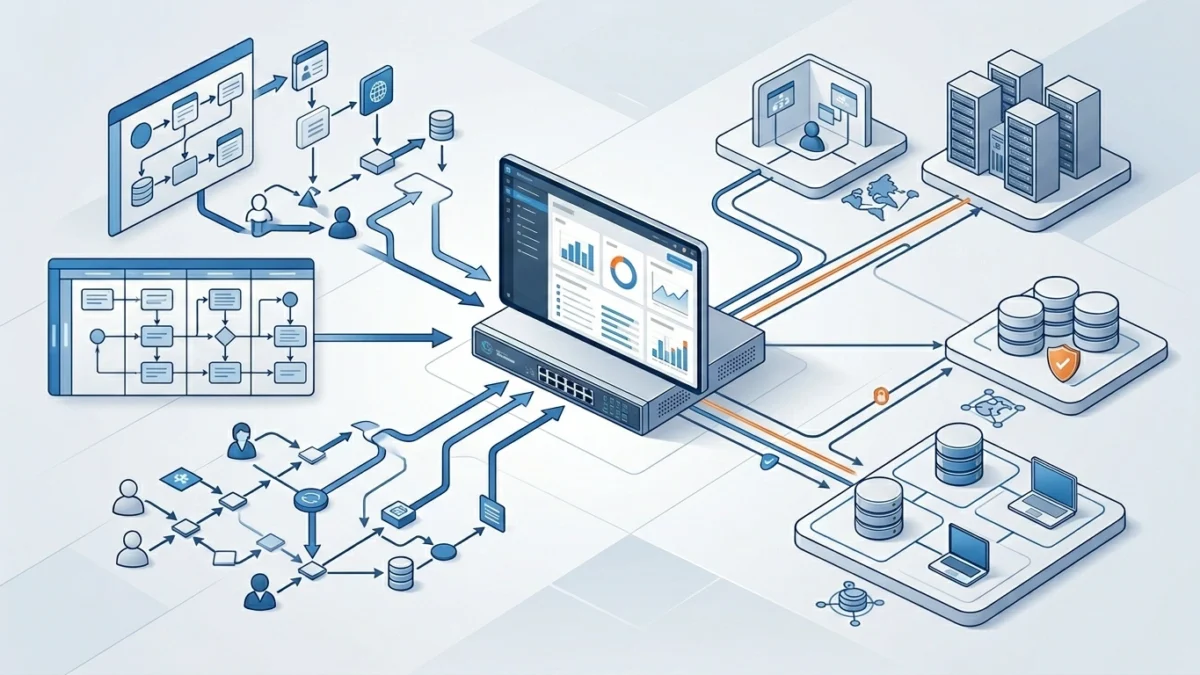
How to Translate Business Processes into Firewall Requirements
Introduction
A firewall does not protect a business well when its rules come only from technical assumptions. It protects the business when its configuration reflects how the company actually works: which departments use which applications, which systems exchange data, which users need remote access, which partners connect to internal platforms, and which services must remain isolated from unnecessary traffic.
That is why firewall planning should begin with business processes rather than device settings. Before engineers define zones, ports, routes, and policies, the organization needs to understand what happens inside its operations. Sales teams use customer systems. Finance teams access accounting platforms. Warehouses exchange data with inventory tools. Remote employees use VPN or cloud applications. Administrators connect to servers. Backup systems move large amounts of data at scheduled times. Each of these processes creates firewall requirements.
When companies skip this translation stage, they often receive technically functional but operationally weak policies. The firewall may pass traffic, block obvious threats, and generate logs, yet still allow excessive access or disrupt important workflows. The better approach is to turn business activity into clear security requirements before implementation begins.
Start with business logic, not firewall syntax
The first step is to describe business processes in simple operational language. At this stage, the team should not start with ports, protocols, or vendor-specific configuration. It should start with real activity. Who needs access? To what system? From where? For what purpose? How often? What happens if access fails?
This business-first approach prevents a common problem. Technical teams may know that traffic flows from one subnet to another, but business owners know why that traffic exists. Without that explanation, rules can become too broad because no one can confidently narrow them. When the business purpose is clear, the firewall policy can become more precise.
Useful questions for process discovery
- Which departments depend on each system
- Which applications support revenue, operations, finance, logistics, or customer service
- Which users need access from the office, remotely, or through partner networks
- Which systems exchange data automatically in the background
- Which processes involve sensitive data or regulated information
- Which services must remain available during maintenance windows
This stage may feel basic, but it creates the foundation for better technical decisions. A firewall rule with no business reason is just a guess wearing a configuration label.
Identify critical assets and classify their importance
After the company describes its main processes, the next step is to identify the assets that support them. These assets may include servers, databases, cloud platforms, employee workstations, network devices, payment systems, customer portals, file storage, identity systems, and backup infrastructure.
Not all assets need the same firewall treatment. A public-facing website, an internal accounting system, a domain controller, a file server, and a test environment create different risk levels. The firewall requirements should reflect those differences instead of applying one generic policy across the environment.
Asset classification should consider
- Business importance
- Data sensitivity
- Exposure to external networks
- Number of users and departments involved
- Dependency on other systems
- Recovery priority during outages
- Compliance or audit relevance
This classification helps the team decide which assets need strict segmentation, which require controlled administrative access, which can communicate with external services, and which should remain isolated except for carefully approved flows. It also helps prioritize work when the environment is large and cannot be redesigned in one phase.
Map business traffic before writing rules
A firewall requirement is not complete until the team understands traffic flow. Business processes often depend on more connections than users see. A warehouse system may connect to an ERP platform, a label printer service, a reporting database, a cloud API, and an authentication server. From the user side, it looks like one application. From the firewall side, it is a chain of dependencies.
Traffic mapping should document
- Source systems and users
- Destination systems and services
- Required applications, ports, and protocols
- Authentication and identity dependencies
- DNS, time synchronization, update, and monitoring traffic
- Backup, replication, and administrative connections
- External vendors, partners, or cloud services involved
The team should also separate interactive user traffic from system-to-system traffic. A user opening a web application and a server synchronizing data with another server may both use network access, but they need different rule logic, different monitoring expectations, and different risk controls.
Do not trust old diagrams blindly
Many companies have network diagrams that look official but no longer match reality. New applications appeared. Temporary access stayed permanent. Administrators added exceptions during urgent incidents. Departments adopted cloud tools. Remote work changed traffic patterns. A firewall project should verify current traffic instead of relying only on historic documentation.
Convert business processes into security zones
Once the team understands assets and traffic flows, it can start translating business processes into zones. A zone is a logical area with similar trust level, function, or risk profile. Good zoning helps the firewall enforce boundaries that match the business structure and security needs.
Common zone examples
- User workstations
- Server environments
- Production applications
- Development and testing systems
- Guest Wi-Fi
- Remote access users
- Administrative management network
- Public-facing services
- Backup infrastructure
- Partner or vendor access areas
The goal is not to create as many zones as possible. The goal is to create meaningful boundaries. Too few zones create excessive trust. Too many zones create operational complexity that the team may struggle to maintain. The right structure depends on business risk, network maturity, staffing, and application architecture.
At this stage, companies often benefit from structured design of firewall work because zone logic, traffic control, high availability, routing, and future scalability need to fit together before implementation begins.
Build firewall rules from approved business requirements
Firewall rules should not grow from random requests. They should come from approved requirements. Each rule should have a clear business purpose, defined source, defined destination, necessary service, owner, review date, and expected behavior in logs.
A good firewall rule request should include
- Business reason for the access
- Requesting department or application owner
- Source user group, device, server, or network
- Destination system or service
- Required ports and protocols
- Duration of access if temporary
- Risk level and approval authority
- Testing criteria after implementation
This structure reduces guesswork. It also prevents rule sprawl, where old exceptions remain active long after the original business need disappears. In many environments, excessive rules do not come from one bad decision. They come from hundreds of small requests that no one reviews afterward.
Least privilege must remain practical
The principle of least privilege says that access should include only what is necessary. However, the policy still needs to support real work. If rules become too restrictive without proper testing, users will face downtime, and teams will start creating emergency exceptions. A practical approach limits access carefully but validates requirements with business owners and technical evidence.
Handle exceptions before they become permanent risk
Every environment has exceptions. Legacy systems, vendor tools, old applications, temporary projects, urgent maintenance, or integration constraints may require access that does not fit the ideal model. The problem is not the existence of exceptions. The problem is unmanaged exceptions.
Each exception should have
- A documented business reason
- A named owner
- An approval record
- A defined expiration or review date
- Compensating controls if risk remains high
- Logging requirements
- A removal plan if the access is temporary
Exceptions without review dates tend to become permanent. Permanent exceptions tend to become invisible. Invisible exceptions tend to become unpleasant discoveries during audits or incidents. That is a terrible life cycle, though admittedly a very common one.
Plan operational management after implementation
Firewall requirements should include post-implementation management. A firewall policy changes as the business changes. New applications appear, departments reorganize, remote access needs shift, and vendors request new connections. Without a management process, even a well-designed policy can become messy over time.
Operational requirements should define
- How access requests are submitted and approved
- Who can authorize emergency changes
- How often rules are reviewed
- How logs are monitored and retained
- How configuration backups are stored
- How rule changes are tested
- How outdated access is removed
- How incidents linked to firewall events are escalated
This is also where organizations should decide whether internal teams will manage the policy alone or rely on outside specialists. In more complex environments, firewall config & service can help translate approved requirements into stable configuration, controlled change processes, and ongoing technical support.
Where expert support adds value
Business teams understand operations. Internal IT teams understand infrastructure history. Security specialists understand exposure, segmentation, monitoring, and control design. A strong firewall requirements process brings these perspectives together instead of letting one group define policy in isolation.
External specialists can help companies challenge vague access requests, identify missing dependencies, structure zones, validate rule logic, and reduce unnecessary exposure. They can also help translate business language into technical policy without losing the reason behind each requirement.
This is especially useful when the environment includes multiple sites, cloud services, remote employees, legacy systems, third-party integrations, or sensitive data. In these cases, security outsourcing can support the company with specialized review, implementation planning, and ongoing governance while the business keeps control over risk decisions.
Business-to-firewall requirements matrix
| Business process | Firewall requirement | Security consideration |
|---|---|---|
| Employees access internal business applications | Allow approved user networks to reach specific application servers | Limit access by role, segment user groups, and log failed connection attempts |
| Finance team works with accounting systems | Restrict access to finance users and necessary supporting services | Apply stronger monitoring because financial data has high business sensitivity |
| Remote employees connect to company resources | Allow VPN or secure remote access only to approved zones | Use identity controls, device checks, and limited access paths |
| Administrators manage servers and network devices | Allow management protocols only from dedicated admin workstations or networks | Separate administrative access from ordinary user traffic |
| Applications exchange data with external platforms | Allow outbound or inbound connections only to approved destinations and services | Validate vendor access, log traffic, and review dependencies regularly |
| Backup systems copy data from production servers | Allow backup traffic between defined servers and backup infrastructure | Protect backup networks from broad user access and monitor unusual transfer patterns |
| Public-facing services receive customer traffic | Allow external access only to published services through controlled paths | Isolate public systems from internal networks and monitor suspicious behavior |
This matrix shows how business activity becomes firewall logic. The exact structure will differ by company, but the method remains the same: define the process, identify the required communication, limit access, assign ownership, and document the reason.
What the business gains from this translation process
- Firewall rules that match real operational needs
- Lower risk of excessive access between systems
- Fewer disruptions during implementation and policy changes
- Better cooperation between business owners, IT teams, and security specialists
- Cleaner documentation for audits and future troubleshooting
- More controlled handling of exceptions and temporary access
- Stronger long-term governance as the company grows
A firewall should not become a collection of technical guesses. It should become a structured control system that reflects how the business operates and what the business needs to protect. When companies translate processes into requirements carefully, they get stronger security without turning daily operations into a maze of blocked connections and frustrated users.
FAQ
Why should firewall requirements start with business processes
Firewall requirements should start with business processes because technical rules need a clear operational reason. When the team understands who needs access, which systems are involved, and why the access matters, it can create more precise and safer policies.
What information is needed before firewall rules are created
The team should document source systems, destination systems, required applications, ports, protocols, user groups, business owners, approval logic, and testing criteria. This information helps prevent overly broad or poorly justified rules.
How often should firewall requirements be reviewed
Firewall requirements should be reviewed after major business or infrastructure changes and on a regular schedule. Many companies review rules quarterly, while complex or regulated environments may need more frequent checks.
What is the biggest mistake when translating business processes into firewall policy
The biggest mistake is converting technical requests directly into rules without verifying the business need. This often creates excessive access, unclear ownership, and policies that become difficult to manage over time.
Should temporary firewall access have an expiration date
Yes. Temporary access should always have an owner, a reason, an approval record, and an expiration or review date. Otherwise, temporary exceptions often become permanent security risk.
Sources
- NIST SP 800-41 Rev. 1 Guidelines on Firewalls and Firewall Policy
- NIST Cybersecurity Framework 2.0
- NIST SP 800-53 Rev. 5 Security and Privacy Controls for Information Systems and Organizations
- CISA Cybersecurity Performance Goals
- ISO/IEC 27001 information security management principles
© 2026 OutsourceITSecurity. All rights reserved.