
How to Translate Business Processes into Firewall Requirements

The Hidden Risks of Running Legacy Firewalls in Modern Business Networks
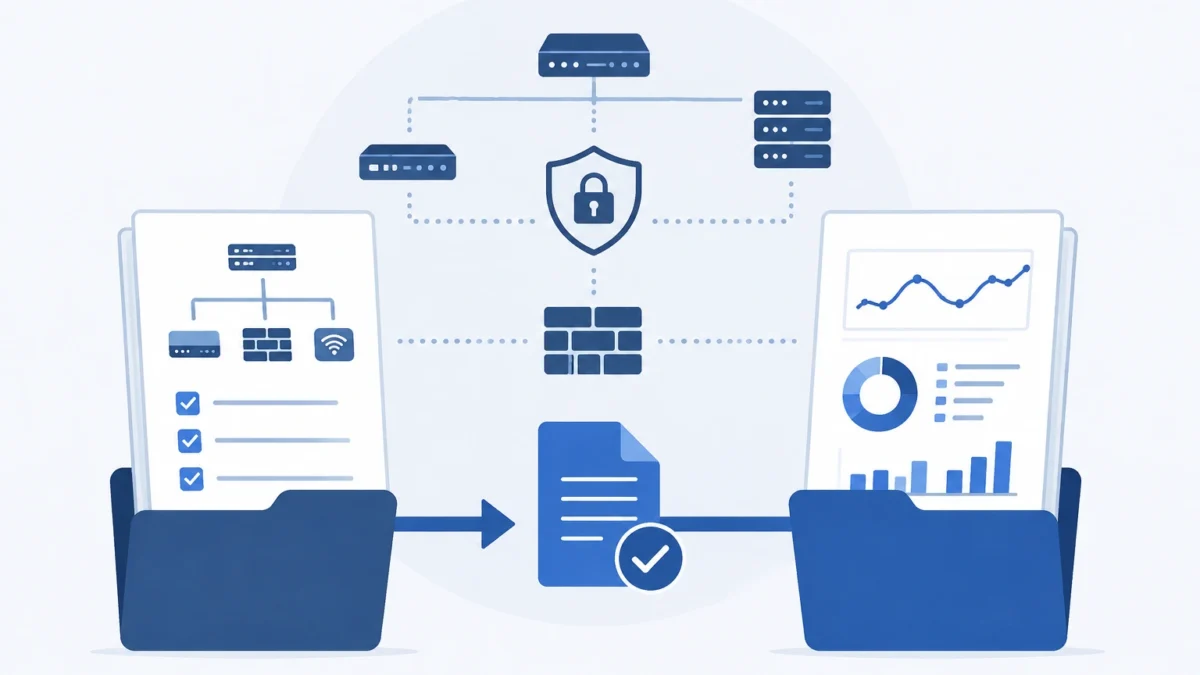
Network Operations Handover: What to Document Before External Security Management Begins
Introduction
A network handover can look simple from the outside. A company gives an external team access, shares several diagrams, opens a few administrative accounts, and expects security operations to continue smoothly. In practice, this approach often creates delays, blind spots, duplicated work, and uncomfortable questions during the first serious incident.
Before a company starts outsourcing computer security, it needs to document how the network actually works. Not how it was designed several years ago. Not how the old diagram claims it works. The real environment: devices, access paths, firewall rules, routing logic, administrator accounts, monitoring sources, backup procedures, escalation contacts, and known weak points.
A good handover does not only help the external team. It protects the business from operational confusion. When documentation is clear, the provider can understand priorities faster, support teams can respond with less guesswork, and management can see which risks still need attention. That is where a handover turns from a boring paperwork exercise into a serious risk-control tool. Not glamorous, but extremely useful.
Why network handover matters before security operations change hands
Security providers can bring strong expertise, but they cannot manage what they cannot see. If network knowledge lives only in the heads of two internal administrators, the external team will need time to reconstruct the environment. During that period, response quality may depend on assumptions, partial diagrams, or emergency calls to people who are already overloaded.
Poor handover usually creates several operational problems:
- Critical devices remain outside monitoring because no one listed them
- Firewall rules lack business owners and review history
- VPN, routing, or remote access dependencies remain unclear
- Legacy services break during maintenance because no one documented them
- Provider engineers cannot distinguish normal traffic from suspicious behavior
- Incident response slows down because escalation paths are incomplete
A structured handover reduces these risks. It gives the external team context before they need to act under pressure. It also forces the company to identify outdated information, undocumented changes, and weak processes before they turn into operational surprises.
Create a complete asset inventory
The first handover document should describe the assets that form the network environment. This includes more than routers and firewalls. A realistic inventory should cover all devices, systems, and services that influence connectivity, access control, monitoring, and security response.
What the inventory should include
- Firewalls, routers, switches, wireless controllers, and access points
- VPN gateways and remote access platforms
- Physical and virtual servers
- Domain controllers, directory services, and identity systems
- Endpoint protection and security management consoles
- Backup servers, storage systems, and recovery platforms
- Cloud connectors, hybrid links, and third-party integrations
- Public-facing services and externally reachable systems
Each asset should have a clear name, location, management address, business purpose, owner, support contact, vendor, model, software or firmware version, warranty status if relevant, and backup status for configuration. This information may seem detailed, but it saves time when the provider needs to troubleshoot an outage, verify exposure, or plan a security improvement.
Prioritize business-critical assets
Not every asset carries the same risk. A core firewall, a domain controller, a payment system, and a production database require more attention than a test device or a non-critical office printer. The inventory should mark criticality so the external team understands which systems deserve priority during monitoring, maintenance, and incident response.
Document real network topology and traffic paths
Network topology is one of the most important parts of a handover. It shows how sites, segments, devices, servers, users, and external connections fit together. However, topology documentation should not stop at a beautiful diagram. It should explain how traffic actually moves and where security controls apply.
Topology documentation should cover
- Physical and logical network diagrams
- VLANs, subnets, zones, and trust boundaries
- Routing paths between internal segments
- Internet breakout points and perimeter controls
- VPN tunnels, site-to-site connections, and remote user access
- Cloud connectivity and hybrid infrastructure paths
- Management networks and administrator access routes
- Guest networks and isolated environments
This information becomes especially important for companies that rely on local infrastructure. When the external team supports on premises network management, it needs a precise view of how internal segments, network devices, physical sites, and local dependencies interact. Without that view, even routine changes can create unexpected side effects.
Show normal traffic, not only network structure
A topology map tells where systems are located. A traffic map tells how they communicate. Both are necessary. The handover should document critical application flows, administrative access, DNS, authentication, backups, monitoring, patch repositories, partner connections, and any high-volume or scheduled traffic that could look unusual in logs.
This helps the provider separate expected behavior from suspicious activity. If a backup job sends large volumes of data every night, the team should know that. If an application server regularly connects to an external vendor platform, that should be documented too. Otherwise, the first week of monitoring may become a festival of false alarms.
Document administrative access and account ownership
Access documentation deserves serious attention because many security incidents involve weak, excessive, shared, or forgotten credentials. During handover, the company should review who can access network devices, servers, security platforms, VPN systems, and management consoles.
Access documentation should include
- Administrator groups and individual privileged accounts
- Service accounts and their technical purpose
- Shared accounts that need replacement or tighter control
- Multi-factor authentication status
- Remote access methods and allowed source locations
- Password vaulting or privileged access management procedures
- Account removal process for employees, vendors, and provider staff
- Approval workflow for new privileged access
The handover should also define how the external team receives access. Temporary emergency access and long-term administrative access require different controls. The provider should not receive broad access simply because documentation is incomplete. Access should match scope, responsibility, and risk.
Service accounts need owners too
Service accounts often survive for years without clear ownership. They run integrations, backup jobs, monitoring agents, scripts, and internal services. If no one knows what a service account does, the company may hesitate to disable it even when it looks risky. During handover, each service account should receive an owner, purpose, dependency description, and review schedule.
Prepare network device configuration records
External security support depends heavily on device configuration. Firewalls, switches, routers, VPN gateways, and wireless systems enforce many of the controls that protect the business. If their configuration history is unclear, troubleshooting and risk assessment become harder.
Device records should document
- Current configuration backups
- Firmware or software versions
- High availability status and failover logic
- Routing protocols and static routes
- Firewall policies and NAT rules
- VPN tunnel settings and peer contacts
- Wireless network settings and segmentation
- Management interfaces and allowed access paths
- Known issues, temporary workarounds, and pending changes
Firewall policy deserves a separate review. The handover should identify rule owners, business reasons, expired exceptions, unused rules, broad allow rules, temporary access that became permanent, and logging settings. Even when the provider will not redesign the firewall immediately, it needs to know where risk may already exist.
Configuration backups should be tested
A backup that no one has tested is more of a comforting rumor than a recovery plan. Before handover, the company should confirm where configuration backups are stored, who can access them, how often they are updated, and whether restoration has been tested. This becomes critical during failed updates, hardware replacement, migration, or incident recovery.
Document monitoring, logs, and alert sources
Monitoring is only useful when the team knows what it receives, what it misses, and what needs action. During handover, the company should document all log sources, monitoring platforms, alert rules, notification channels, and reporting expectations.
Monitoring documentation should cover
- Network device logs
- Firewall and VPN events
- Endpoint protection alerts
- Server and application logs
- Identity and authentication events
- Backup job results
- Availability and performance monitoring
- SIEM, EDR, or other security platform integrations
The documentation should also explain alert severity. Not every failed login requires the same response as suspicious administrator activity. Not every blocked connection means an attack. The provider needs rules for triage, escalation, suppression, and investigation. Otherwise, monitoring can produce noise instead of insight.
Define log retention and evidence needs
Logs support troubleshooting, incident investigation, and audit evidence. The handover should define how long logs are stored, where they are stored, who can access them, and which logs are critical for compliance or internal reporting. If retention is too short, the company may discover after an incident that the evidence disappeared before anyone asked for it. That is not a fun discovery. It is usually followed by a very serious meeting.
Document change management and incident procedures
The external team must understand how changes happen. Network operations involve constant movement: new users, new systems, firewall changes, VPN requests, routing updates, patches, certificates, device replacements, and emergency fixes. Without a clear change process, the provider may either act too cautiously or change too much too quickly.
Change documentation should define
- Standard change request format
- Approval authority for different change types
- Maintenance window rules
- Testing and validation steps
- Rollback requirements
- Emergency change procedure
- Documentation updates after implementation
- Communication rules for affected users or departments
Incident procedures need the same clarity. The handover should show who receives alerts, who performs first triage, who can isolate systems, who communicates with management, who contacts legal or compliance stakeholders, and who prepares the post-incident review.
Emergency authority must be explicit
During a serious incident, the provider may need to block traffic, disable accounts, isolate a segment, or change firewall policy quickly. The company should define when the provider can act immediately and when internal approval is mandatory. Clear authority reduces hesitation without removing accountability.
Build a practical transition plan
A handover should not happen as one large data dump. The external team needs time to review documentation, ask questions, verify access, validate monitoring, and understand business priorities. A transition plan helps structure this process.
A practical transition plan should include
- Initial documentation package
- Technical discovery sessions with internal administrators
- Access provisioning and validation
- Monitoring source verification
- Review of critical systems and known risks
- Test incident or escalation simulation
- First-month reporting expectations
- Schedule for documentation corrections and improvements
The first weeks should focus on stabilization and visibility. The provider should confirm what it can monitor, what remains unclear, which assets need better documentation, and which risks require immediate attention. This prevents a rushed transition from creating a false sense of control.
Where expert support adds value during handover
Many companies start the handover process and quickly discover that their network documentation is incomplete. That is normal. Environments change faster than diagrams, and busy teams rarely have perfect records. The important point is to close the most dangerous gaps before the external team takes responsibility for security operations.
Specialists can help structure asset inventories, verify topology, review firewall rules, assess access controls, identify monitoring gaps, and build a cleaner operating model. They can also separate urgent security issues from long-term improvement tasks, which helps management avoid panic and prioritize work sensibly.
A good handover does not require perfection. It requires honesty, ownership, and enough detail for the provider to support the environment without guesswork. The company should know what is documented, what is missing, what is risky, and what needs improvement in the first phase.
Network operations handover matrix
| Documentation area | What to include | Why it matters |
|---|---|---|
| Asset inventory | Network devices, servers, security platforms, cloud links, owners, criticality, versions | Helps the provider understand what exists and what deserves priority |
| Topology and traffic | Diagrams, zones, VLANs, routing paths, VPN links, application flows, dependencies | Reduces troubleshooting time and improves security monitoring accuracy |
| Access control | Admin accounts, service accounts, MFA status, remote access methods, approval workflow | Prevents excessive access and improves accountability |
| Device configuration | Backups, firewall rules, NAT, routing, VPN settings, known issues, failover logic | Supports maintenance, recovery, and risk review |
| Monitoring and logs | Log sources, alert rules, retention, severity levels, reporting expectations | Improves incident detection, investigation, and audit readiness |
| Change management | Approval process, emergency changes, maintenance windows, rollback plans, communication | Keeps network operations controlled after the handover |
| Incident response | Escalation contacts, decision authority, containment rules, reporting process | Speeds up response when security events or outages happen |
This matrix can serve as a starting point, but every company should adapt it to its infrastructure, risk level, internal team structure, and provider scope. The goal is not to create a perfect binder of documents. The goal is to make daily operations and security response predictable.
What a strong handover gives the business
- Faster provider onboarding and fewer first-month surprises
- Clearer visibility into critical assets and network dependencies
- Better control over privileged access and service accounts
- Cleaner firewall, VPN, routing, and monitoring documentation
- Lower risk during maintenance, migration, and emergency changes
- More effective incident response and escalation
- Stronger audit readiness and management reporting
A network handover is not just preparation for a vendor relationship. It is a chance to understand the real state of the environment. Sometimes the documentation process reveals forgotten systems, risky exceptions, old accounts, and strange routing paths that no one wants to admit were still alive. Finding those issues before an incident is much better than discovering them while everyone stares at a dashboard and pretends the old diagram is still accurate.
FAQ
What should be documented first during a network operations handover
The first priority should be a complete asset inventory and current network topology. The provider needs to know which devices, systems, segments, and traffic paths exist before it can support or secure them effectively.
Why is access documentation so important
Access documentation shows who can administer systems, how privileged accounts are controlled, which service accounts exist, and how remote access works. This helps reduce the risk of unmanaged credentials and unclear accountability.
Should firewall rules be reviewed during handover
Yes. Firewall rules should be reviewed for ownership, business purpose, logging, broad permissions, temporary exceptions, and outdated access. Even if redesign comes later, the provider needs to understand current policy risks.
How long should the transition period last
The transition period depends on environment size and complexity. A small environment may need a short onboarding phase, while a multi-site or hybrid infrastructure usually needs a longer discovery and validation period.
What is the biggest handover mistake
The biggest mistake is giving the provider access without context. Access alone does not create control. The provider needs documentation, ownership rules, escalation paths, monitoring visibility, and clear decision authority.
Sources
- NIST Cybersecurity Framework 2.0
- NIST SP 800-61 Rev. 2 Computer Security Incident Handling Guide
- NIST SP 800-53 Rev. 5 Security and Privacy Controls for Information Systems and Organizations
- NIST SP 800-92 Guide to Computer Security Log Management
- CISA Cybersecurity Performance Goals
- ISO/IEC 27001 information security management principles
© 2026 OutsourceITSecurity. All rights reserved.